Pulumi logo

Posts Tagged features

Introducing pulumi do: Direct Resource Operations for Any Cloud

Introducing pulumi do: Direct Resource Operations for Any Cloud

Infrastructure as code is the right model for production systems. State tracking, drift detection, and repeatable deployments all matter when you’re managing real workloads.

But sometimes, you also need a quick, one-off interaction with the cloud: create a bucket or a database, look up a VPC, delete a stray resource.

Today we’re introducing pulumi do, a new command for direct resource operations. With pulumi do, you can create, read, update, delete, and query any cloud resource from the terminal with a single command, across thousands of Pulumi-supported providers — no project, code, or state required.
Read more →

Neo, Now in the Terminal

Neo, Now in the Terminal

Since launching Pulumi Neo, over 4,500 organizations have used it to delegate real infrastructure work: scaffolding, migrating, investigating, operationalizing, and more. Though that usage has come entirely through Pulumi Cloud, we know a large portion of Pulumi users live in the terminal, and increasingly that’s where AI tools run too. Now we’re bringing Neo there.

pulumi neo brings the same Neo experience you’ve had in Pulumi Cloud to your terminal. Running locally means there’s no separate branch to push, no credentials to provision, and no context to paste: Neo picks up the setup you already have.

pulumi neo working through a Kubernetes cluster check, with Flux GitOps state verified and a TODO list in progress

Read more →

Neo Integrations: MCP Servers and Cloud CLIs

Neo Integrations: MCP Servers and Cloud CLIs

Pulumi Neo already understands your infrastructure: your code, your stacks, your state. Today we’re launching new capabilities that extend Neo’s reach in two directions: into the third-party systems your team uses to plan and observe, and out to the cloud CLIs that actually drive your infrastructure.

The first half is MCP integrations: connections to Atlassian, Datadog, Honeycomb, Linear, PagerDuty, and Supabase that show up as tools Neo can call during a task. The second half is CLI integrations: scopable access to aws, gcloud, az, and kubectl. Both are configured once at the org level and available to every Neo task in the organization.

Read more →

Better CLI Interactions for Agents and Humans

Better CLI Interactions for Agents and Humans

AI agents do a lot of their work through CLIs. They’re easier to call than HTTP APIs and they produce predictable output. Over the last few months our own CLI traffic has shifted from mostly people typing commands to people and agents running commands together, often in the same session.

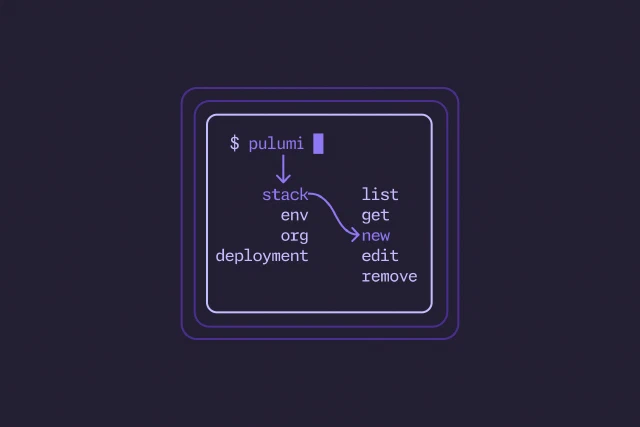
Today we’re shipping a release built for both. The Pulumi CLI is reorganized around three ideas: the right command should be the one you can guess, anything you can do in Pulumi Cloud should also be doable from the terminal, and what comes back should be just as readable to an agent as it is to a person.

Read more →

The Agentic Infrastructure Era

The Agentic Infrastructure Era

The first frontier agents excelled at was coding. The reason is evident: we have billions of lines of self-documenting code available on the internet for the LLMs to learn from. We can measure their performance on coding thanks to linters, type checkers, compilers, and test suites. The most advanced agentic systems to hit product/market fit have been coding-oriented, and it has resulted in an intense velocity increase in how much and how fast code we can write.

But as the AI tsunami whips up reams of code, what happens to it becomes just as critical. As an industry, we’ve moved beyond just coding to engineering, which includes documentation, tests, automation, and, yes, managing the very infrastructure our applications need to run. The deeper into production you go, however, the less good agents naturally are at helping. At Pulumi, we live and breathe infrastructure, and have seen this firsthand. But we’ve also been hard at work building the platform this new era runs on. In this post, I’ll share our point of view, what we’ve built, what we’re launching today, and why all infrastructure is about to be agentic.

Read more →

Connect Any Git or Mercurial Repo to Pulumi with Custom VCS

Connect Any Git or Mercurial Repo to Pulumi with Custom VCS

Custom VCS is a new Pulumi Cloud integration that connects any Git or Mercurial version control system to Pulumi Deployments using webhooks and centrally managed credentials. Pulumi Cloud already has native integrations with GitHub, GitLab, and Azure DevOps, but if your team uses a self-hosted or third-party VCS, you’ve been limited to manually configuring credentials per stack with no webhook-driven automation. Custom VCS closes that gap.

Read more →

The infrastructure as code platform for any cloud.