Private Registry
Pulumi Private Registry is the source of truth for an organization’s infrastructure building blocks like components and templates. Platform engineers publish components to the private registry so that developers can discover them, browse auto-generated API documentation, and use them in their Pulumi programs.
For detailed information about different component packaging approaches, see Packaging Components.
Before you begin
- You need a Pulumi Cloud account on the Enterprise or Business Critical plan.
- You need the Pulumi CLI installed.
- Your component must be pushed to a GitHub or GitLab repository that Pulumi can access. Private repositories are supported — see Authenticating with private repositories.
- If you haven’t built a component yet, see Build a Component.
Quick start
The following example publishes a component from a GitHub repository to your organization’s private registry:
# Tag a version in your component repository
git tag v1.0.0
git push origin v1.0.0

# Publish to your organization's private registry
pulumi package publish github.com/<org>/<component-name>@1.0.0
That’s it. Pulumi introspects your component, generates API documentation, and makes it available in your organization’s private registry. The sections below cover each step in detail.
Publish a component
The pulumi package publish command publishes a component to the private registry:
pulumi package publish <provider|schema>
For example, if your GitHub organization is ACME and you are publishing the k8s-cluster component:
pulumi package publish github.com/acme/k8s-cluster
Versioning
Pulumi uses git tags for versioning components. By default, the latest version tag will be used. The tag must adhere to the semantic versioning standard plus a “v” prefix (e.g. v1.2.3).
To publish a specific version, append an @ followed by the semver version (excluding the “v”) after the git source:
git tag v1.2.3
git push origin v1.2.3
pulumi package publish github.com/acme/k8s-cluster@1.2.3
README
A README is required when publishing a component. Pulumi renders markdown README files in the private registry. They’re a great way to provide context for a component. By default, the Pulumi CLI looks for a README in the component’s root directory. The --readme flag can be used to specify a custom source.
pulumi package publish github.com/acme/k8s-cluster --readme README_LOCATION
Authenticating with private repositories
If your repository is private, a valid GITHUB_TOKEN or GITLAB_TOKEN is required for all commands, including publish, get schema, and when using the component in a program (pulumi install, pulumi up, etc.).
By default, the Pulumi CLI will look for a token in the GITHUB_TOKEN and GITLAB_TOKEN environment variables.
GITHUB_TOKEN="$(gh auth token)"
pulumi package publish github.com/acme/k8s-cluster
Specifying an organization
If you’re part of multiple organizations and do not have a default organization set, you must specify the org by using the --publisher flag.
pulumi package publish github.com/acme/k8s-cluster --publisher ORG_NAME
API documentation
When a new component or component version is published, API documentation is automatically generated listing the component’s inputs and outputs.
Input and output descriptions are generated based on annotations in the code as follows:
// Use JSDocs-like comments to annotate inputs and outputs.
export interface PetAbstractedArgs {
    /**
     * This input represents the size of the pet name to generate. Valid values are "small", "medium", "large", "xlarge", or a number representing the length of the pet name.
     **/
    size: string;
}

export class PetAbstracted extends pulumi.ComponentResource {
    /**
     * This output provides the generated pet name.
     **/
    public readonly petName: pulumi.Output<string>;
# Use Python docstrings to annotate inputs and outputs.
class PetAbstractedArgs(TypedDict):
    size: pulumi.Input[str]
    """This input represents the size of the pet name to generate. Valid values are "small", "medium", "large", "xlarge", or a number representing the length of the pet name."""

class AppImage(pulumi.ComponentResource):
    pet_name: pulumi.Output[str]
    """This output provides the generated pet name."""
// Use Annotate() to create annotations for go component inputs and outputs.
type PetAbstractedArgs struct {
	Size pulumi.StringInput 	`pulumi:"size"`
}

func (f *PetAbstractedArgs) Annotate(a infer.Annotator) {
	a.Describe(&f.Size, "This input represents the size of the pet name to generate. Valid values are "small", "medium", "large", "xlarge", or a number representing the length of the pet name.")
}

type PetAbstractedOutputs struct {
  PetName pulumi.StringOutput `pulumi:"petName"`
}
func (f *PetAbstractedOutputs) Annotate(a infer.Annotator) {
	a.Describe(&f.PetName, "This output provides the generated pet name.")
}
// Component API Docs annotations are not currently supported in .NET.
// Component API Docs annotations are not currently supported in Java.
Troubleshooting
| Problem | Solution |
|---|---|
error: no README found | Add a README.md to your component’s root directory, or use the --readme flag to specify a custom location. |
error: no version tag found | Tag your repository with a semver tag (e.g. git tag v1.0.0) and push it (git push origin v1.0.0). |
| Authentication failures with private repos | Set the GITHUB_TOKEN or GITLAB_TOKEN environment variable. For GitHub, use GITHUB_TOKEN="$(gh auth token)". |
| Wrong organization | Use the --publisher flag to specify the correct organization, or set a default with pulumi org set-default. |
Browsing the registry
The Platform menu in the Pulumi Cloud console includes two package views:
Registry
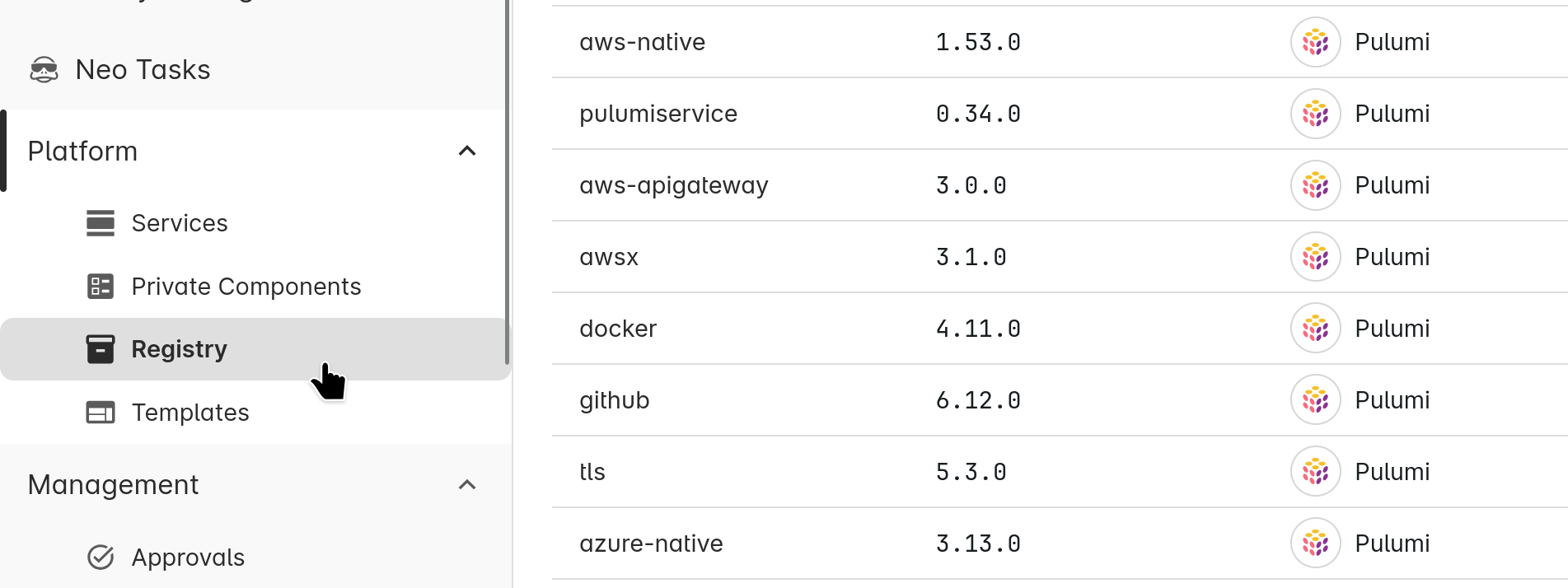
Browse all packages available to your organization, including public providers and components from pulumi.com/registry plus your organization’s private packages. Features include:
- View documentation for any version of a package
- See usage data showing how packages are adopted across your organization
- Filter by usage status to find packages that need attention
Private components
This tab shows only the component packages published by your organization via pulumi package publish.
Usage tracking
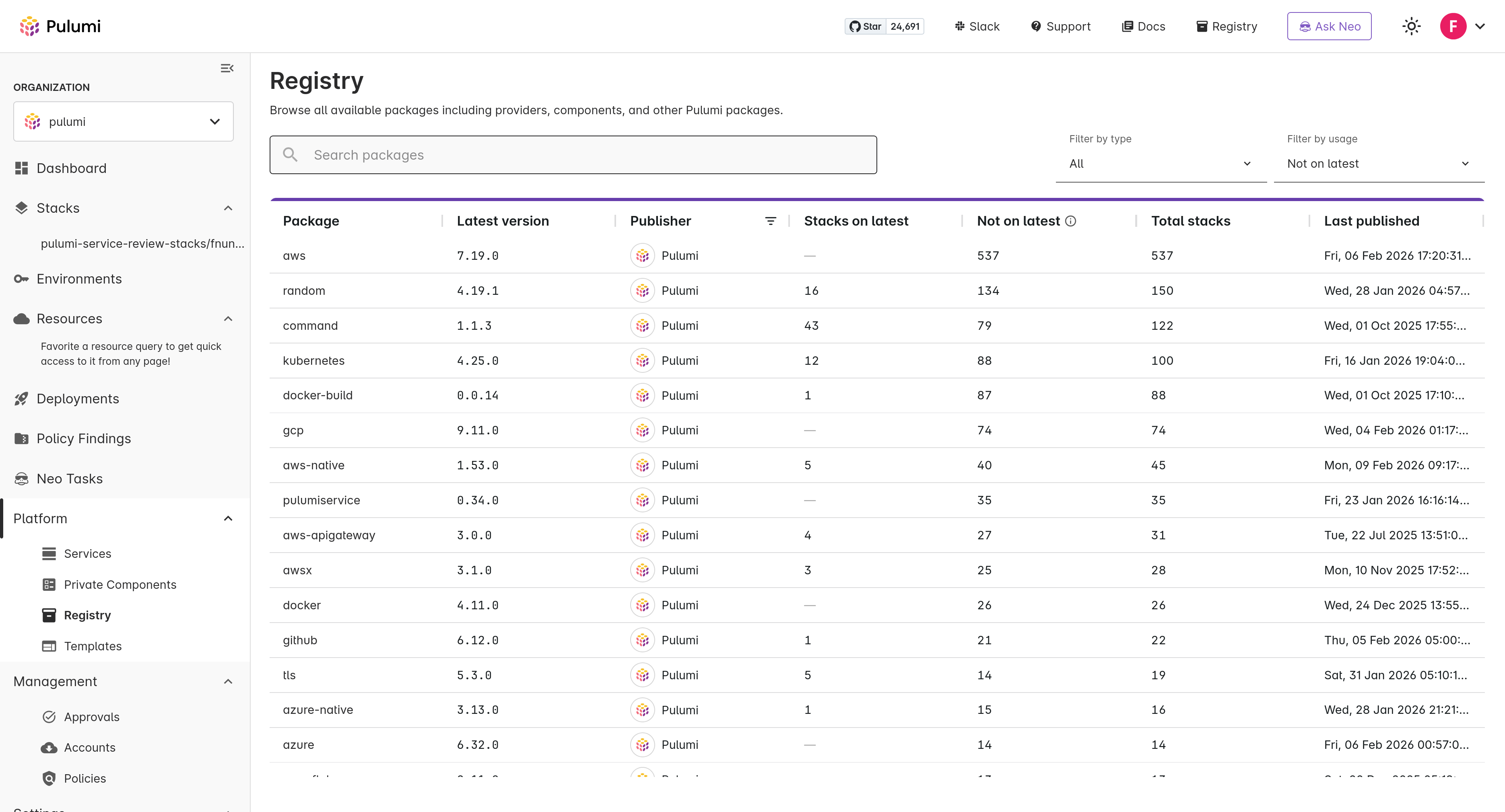
Both package list views display usage columns for each package: how many stacks are on the latest version, how many are on older versions, and the total number of stacks using the package. You can filter the list to show only used packages, unused packages, or packages where stacks are running older versions.
Each package page also includes a “Used by” tab showing which stacks use that package, including the stack name, project, version in use, and last update timestamp. This helps you assess the impact of changes before updating versions and identify stacks that may need upgrading.
Templates
Organization templates are an efficient way to scaffold new Pulumi programs. Templates are available to users in the private registry and New Project Wizard.
Templates can be published directly to the Private Registry using the pulumi template publish command, or sourced from configured GitHub or GitLab repositories. For detailed information on template publishing and management, see Organization Templates.
Thank you for your feedback!
If you have a question about how to use Pulumi, reach out in Community Slack.
Open an issue on GitHub to report a problem or suggest an improvement.